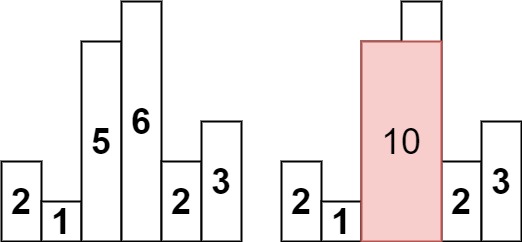
Input: heights = [2,1,5,6,2,3]
Output: 10

The next smaller element to the right and the next smaller element to the left. The width of the rectangle is (right-left-1) if the NSE to the right and the NSE to the left.
package pep.Day26;

import java.util.Stack;

public class Largest_Area_Histogram {
    public static void main(String[] args) {
        int[] arr = {2, 1, 5, 6, 2, 3};

        // this will start from right
        int[] nextSmallerToLeft = nextSmallerToLeft(arr);
        display(nextSmallerToLeft);

        // this will start from left
        int[] nextSmallerToRight = nextSmallerToRight(arr);
        display(nextSmallerToRight);

        int maxArea = Integer.MIN_VALUE;
        for (int i = 0; i < nextSmallerToLeft.length; i++) {
            int length = (nextSmallerToRight[i] - nextSmallerToLeft[i] - 1);
            int area = length * arr[i];
            maxArea = (int) Math.max(area, maxArea);
        }
        System.out.println(maxArea);
    }

    private static int[] nextSmallerToLeft(int[] arr) {
        Stack<Integer> stack = new Stack<>();
        int n = arr.length;
        int[] ans = new int[n];

        for (int i = 0; i < n; i++) {
            while (!stack.isEmpty() && arr[i] <= arr[stack.peek()]) stack.pop();
            // if smaller to right not found, insert in ans -1
            ans[i] = stack.isEmpty() ? -1 : stack.peek();
            stack.push(i);
        }
        return ans;
    }

    private static void display(int[] ans1) {
        for (int x : ans1)
            System.out.print(x + "\t");
        System.out.println();
    }

    private static int[] nextSmallerToRight(int[] arr) {
        Stack<Integer> stack = new Stack<>();
        int n = arr.length;
        int[] ans = new int[n];

        for (int i = n - 1; i >= 0; i--) {
            while (!stack.isEmpty() && arr[i] <= arr[stack.peek()]) stack.pop();
            // if smaller to left not found, insert in ans size_of_array
            ans[i] = stack.isEmpty() ? n : stack.peek();
            stack.push(i);
        }
        return ans;
    }
}


No comments:
Post a Comment