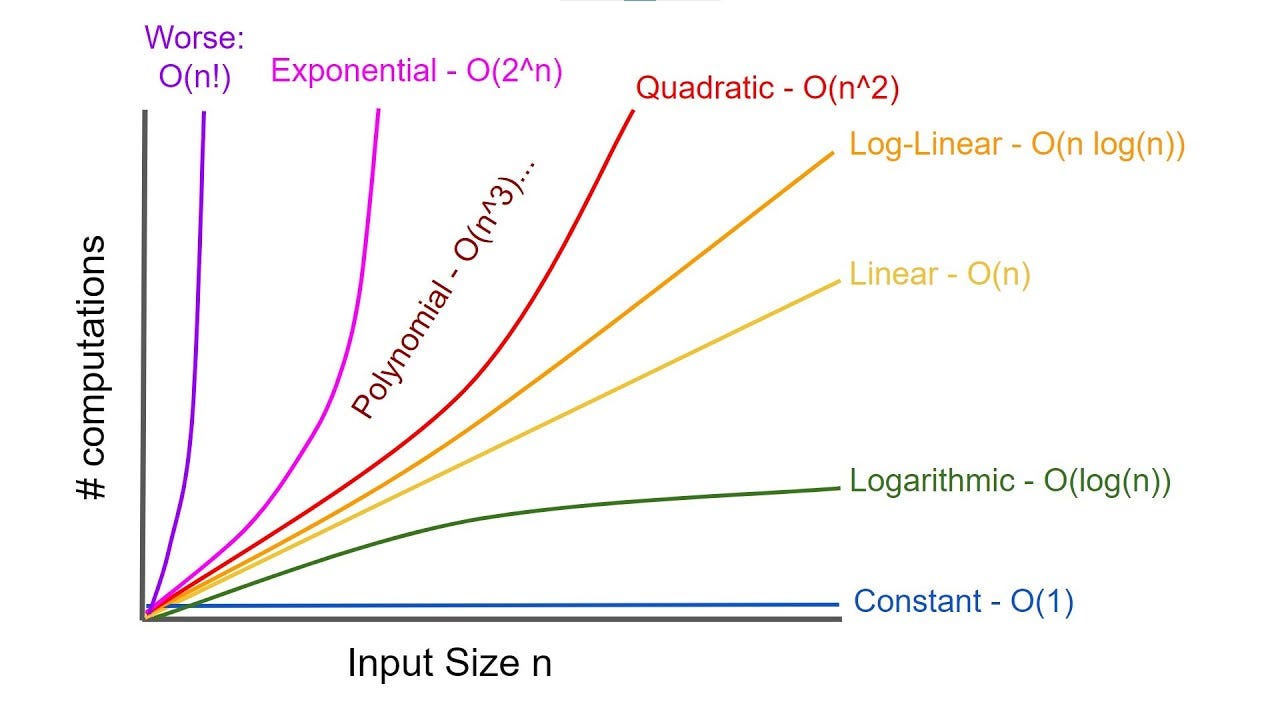
O(1) < O(log n) < O(n) < O(n log n) < O(n ^ 2) ..... < O(2 ^ n) < O(n!)
Try to keep TC till O(n ^ 2)
===========================================================================
O(n) * O(log n) = O( n * (log n) )
O(a) + O(b) = O(a+b) = O(a), if a > b
eg. O( n ^ 2) + O (2 ^ n) = O (2 ^ n)
since, O( n ^ 2) < O (2 ^ n)
===========================================================================
// Time Complexity: O(log n)
// This loop doubles i: i = 1, 2, 4, 8, 16 (stops when i >= n)
for (int i = 1; i < n; i = i / 2) {
System.out.println("i = " + i);
}
===========================================================================
🔁 Loop Complexity Comparison: O(n) vs O(log n) vs O(log log n)
1. ✅ O(n) — Linear Growth
-
Iterates from 0 to
n-1 -
Runs n times
-
📈 Time Complexity: O(n)
2. ✅ O(log n) — Exponential Shrinkage
-
Each step divides
iby 2 -
Runs about log₂(n) times
-
📈 Time Complexity: O(log n)
3. ✅ O(log log n) — Double Logarithmic Growth
💡 Why O(log log n)?
Let’s break it down:
-
i = 2 -
i = 4(2²) -
i = 16(4²) -
i = 256(16²) -
i = 65536(256²) -
...
If you start from i = 2 and repeatedly do i = i², the number of iterations to reach n is:
log log n
Because:
-
2^2 = 4 -
2^4 = 16 -
2^16 = 65536 -
So you're doing a logarithm inside a logarithm
📈 Time Complexity: O(log log n)
🔁 Code:
✅ Time Complexity: O(log n)
🧠 Explanation:
-
istarts at 1 and doubles on each iteration:
1, 2, 4, 8, 16, ..., < n -
The number of times you can double
ibefore it reaches or exceedsnis about log₂(n).
🔁 Code:
✅ Time Complexity: O(log₃ n)
🧠 Explanation:
-
The value of
iincreases by multiplying it by 3 each time. -
So the values go like:
1, 3, 9, 27, 81, ..., < n -
If we denote the number of iterations as
k, then: -
Therefore, it runs about
log₃(n)times, which is asymptotically stillO(log n)— just with a different base.
Does O(n) supports till 10 ^ 9
In theory, yes — O(n) means the time grows linearly with input size.
But in practice, O(n) does not support input size n = 10⁹.
🧠 Why Not in Practice?
Because on a modern machine or coding platform (like LeetCode, Codeforces, etc.), you are typically allowed 1 to 2 seconds to run your code.
And most systems can safely perform about:
-
10⁷ to 10⁸ operations per second
📉 What Happens If n = 10⁹?
-
An
O(n)algorithm would need ~10⁹ operations -
That would take ~10 seconds or more — too slow
-
Your solution will likely Time Out (TLE)
✅ Practical Limit for O(n)
| Time Limit | Max Input Size for O(n) |
|---|---|
| 1 sec | ~10⁷ (safe), maybe up to 10⁸ (tight) |
| 2 sec | ~2 × 10⁷ – 2 × 10⁸ |
| 10⁹ | ❌ Not feasible for O(n) in competitive coding |
🧪 Exception: When is n = 10⁹ OK?
Only if you're not actually doing work on every element, such as:
-
Just reading input of size
10⁹(rare) -
Doing
O(1)orO(log n)work (e.g., binary search)
✅ Summary:
| Scenario | O(n) Feasible? |
|---|---|
n ≤ 10⁷ | ✅ Safe |
n ≈ 10⁸ | ⚠️ Risky |
n = 10⁹ | ❌ Too large |
Let me know the context (e.g., array processing, loops, I/O), and I can give a more specific answer.


No comments:
Post a Comment