Example 1:
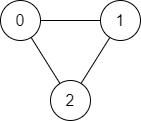
Input: n = 3, edges = [[0,1],[1,2],[2,0]], source = 0, destination = 2
Output: true
Explanation: There are two paths from vertex 0 to vertex 2:
- 0 → 1 → 2
- 0 → 2
package pep.Day38;

import java.io.BufferedReader;
import java.io.InputStreamReader;
import java.util.ArrayList;

public class Has_Path_LeetCode_1971 {

    public static void main(String[] args) throws Exception {
        int[][] edges = {{0, 1}, {1, 2}, {2, 0}};
        System.out.println(validPath(3, edges, 0, 2));
    }

    public static boolean validPath(int n, int[][] edges, int source, int destination) {

        ArrayList<ArrayList<Integer>> graph = new ArrayList<>();
        for (int i = 0; i < n; i++) {
            graph.add(new ArrayList<>());
        }

        for (int i = 0; i < edges.length; i++) {
            int src = edges[i][0];
            int dest = edges[i][1];
            graph.get(src).add(dest);
            graph.get(dest).add(src);
        }
        boolean[] visited = new boolean[n];
        boolean res = check(graph, source, destination, visited);

        return res;
    }

    private static boolean check(ArrayList<ArrayList<Integer>> graph, int source, int destination, boolean[] visited) {
        if (source == destination)
            return true;

//        if (visited[source] != true) {
//            visited[source] = true;
//            for (int nbr : graph.get(source)) {
//                boolean res = check(graph, nbr, destination, visited);
//                if (res)
//                    return true;
//            }
//        }

        visited[source] = true;
        for (int nbr: graph.get(source)){
            if (!visited[nbr]){
                boolean res = check(graph, nbr, destination, visited);
                if (res)
                    return true;
            }
        }


        return false;
    }

}


No comments:
Post a Comment